Have you ever had anti-wrinkle injections, noticed a beautiful improvement in your forehead or frown lines, but still felt that your skin looked creased, textured or lined?
You're not alone.
One of the most common misconceptions about facial ageing is that all lines and wrinkles are caused by muscle movement. In reality, there are different types of lines, and understanding the difference is key to choosing the right fine lines and wrinkles treatment.
While anti-wrinkle injections can be incredibly effective at softening expression lines, they don't necessarily address changes within the skin itself.
At Fine Aesthetic Medicine Clinic (FAM Clinic) in Waterbeach, Cambridge, we take a medically-led, skin-first approach to facial rejuvenation. By understanding whether lines are caused by muscle movement, collagen loss, dehydration or changes in skin structure, we can create a treatment plan that addresses the underlying concern rather than simply treating the visible symptom.
Let's explore the difference.
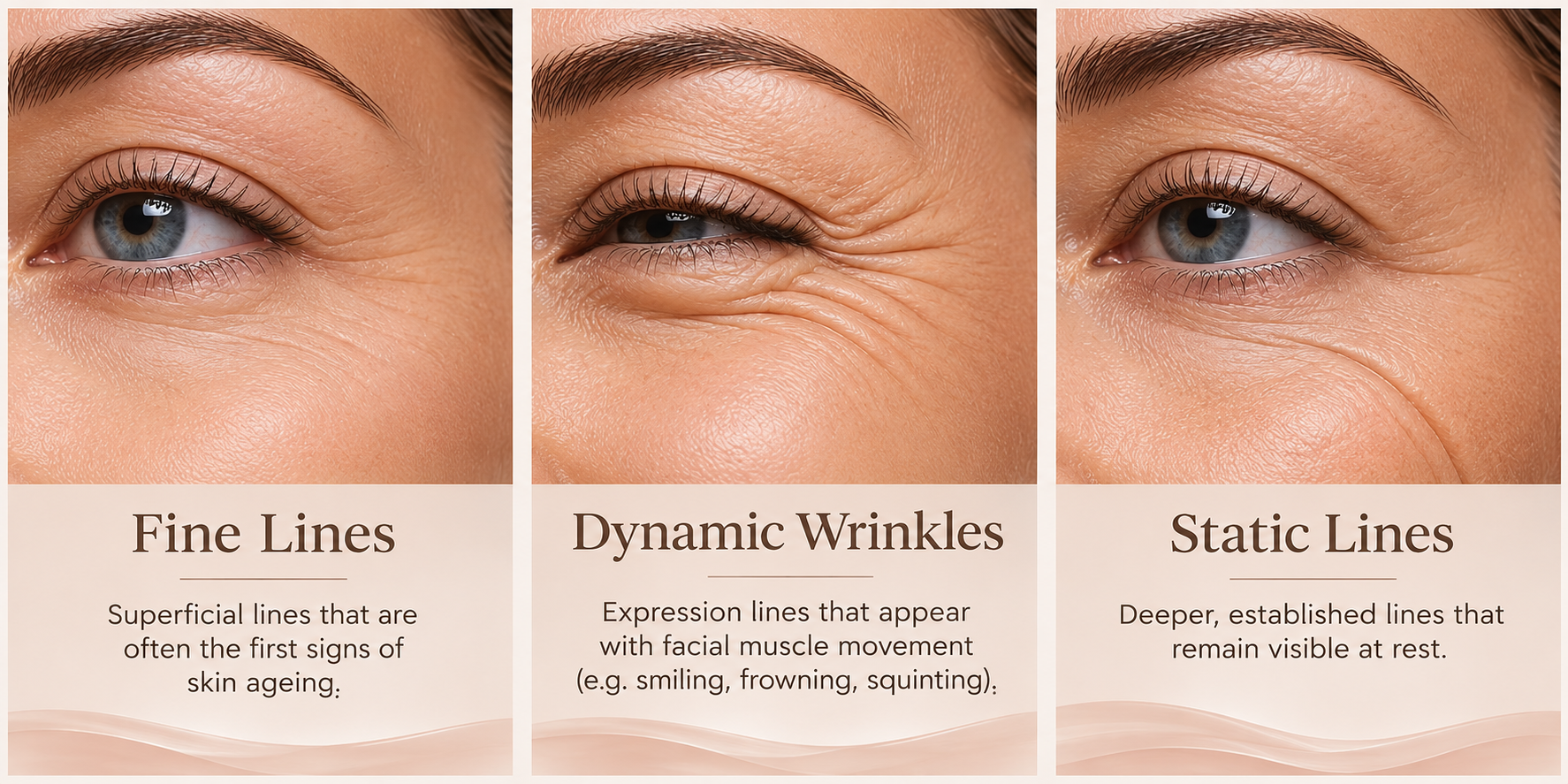
—1. Fine Lines: The First Signs of Skin Ageing
Fine lines are often some of the earliest visible signs of skin ageing. They tend to appear as small, superficial creases across the skin, particularly around the eyes, forehead and mouth.
You may notice them when applying makeup, looking closely in the mirror or when your skin feels particularly dry or dehydrated.
What causes fine lines?
Several factors contribute to their development:
- Collagen decline: Collagen provides structural support to the skin. As we age, natural collagen production gradually decreases, affecting firmness and resilience.
- Reduced elastin: Elastin helps skin return to its original shape after movement. A decline in elastin contributes to reduced elasticity.
- Dehydration: When the skin lacks moisture, fine surface lines can become more noticeable.
- Sun exposure: UV radiation damages collagen and elastin, accelerating premature skin ageing.
- Natural cell turnover changes: As we age, the skin's renewal processes become less efficient, potentially contributing to uneven texture and dullness.
How can fine lines be treated?
The key is improving skin quality, supporting cell renewal and protecting the skin against further damage.
At FAM Clinic, we consider several options:
Medical-grade skincare and Vitamin A
Cosmetic vitamin A derivatives, such as retinol, are valuable ingredients in an evidence-informed skincare programme.
They work by influencing skin cell turnover and supporting collagen remodelling over time. With consistent, appropriate use, they can help improve:
- Fine lines and wrinkles
- Uneven skin texture
- Skin tone and pigmentation
- The appearance of sun damage
- Overall skin smoothness.
We can recommend an individually tailored medical skincare routine built around vitamin A, alongside moisturising and daily SPF protection.
Microneedling
Microneedling works by creating controlled microchannels within the skin, stimulating the body's natural wound-healing response.
This encourages collagen and elastin production as part of the skin's remodelling process.
Over a course of treatments, microneedling can help improve skin texture, soften the appearance of fine lines and support healthier-looking, smoother skin.
Neauvia LaserMe – Non-Ablative Fractional Laser
LaserMe is an advanced non-ablative fractional diode laser treatment designed to improve skin quality without removing the surface layer of skin.
By delivering controlled energy into targeted skin tissue, the treatment aims to stimulate the skin's natural regenerative and remodelling processes.
It can be considered for concerns including fine lines, uneven texture, skin quality and early signs of skin ageing.
The benefit of a non-ablative approach is that the skin surface remains intact, with generally less downtime than more aggressive ablative resurfacing procedures.
—2. Dynamic Wrinkles: Lines Caused by Facial Movement
Dynamic wrinkles are lines that appear when we make facial expressions.
Think about what happens when you:
- Raise your eyebrows.
- Frown or concentrate.
- Smile or laugh.
- Squint in bright sunlight.
These movements cause the underlying facial muscles to contract, folding the skin above them.
Common examples include:
- Horizontal forehead lines.
- Frown lines between the eyebrows (the glabella).
- Crow's feet around the eyes.
Initially, these lines may only be visible when you make an expression. However, as the skin gradually loses collagen, elastin and its ability to recover, repeated folding can contribute to lines becoming more permanent.
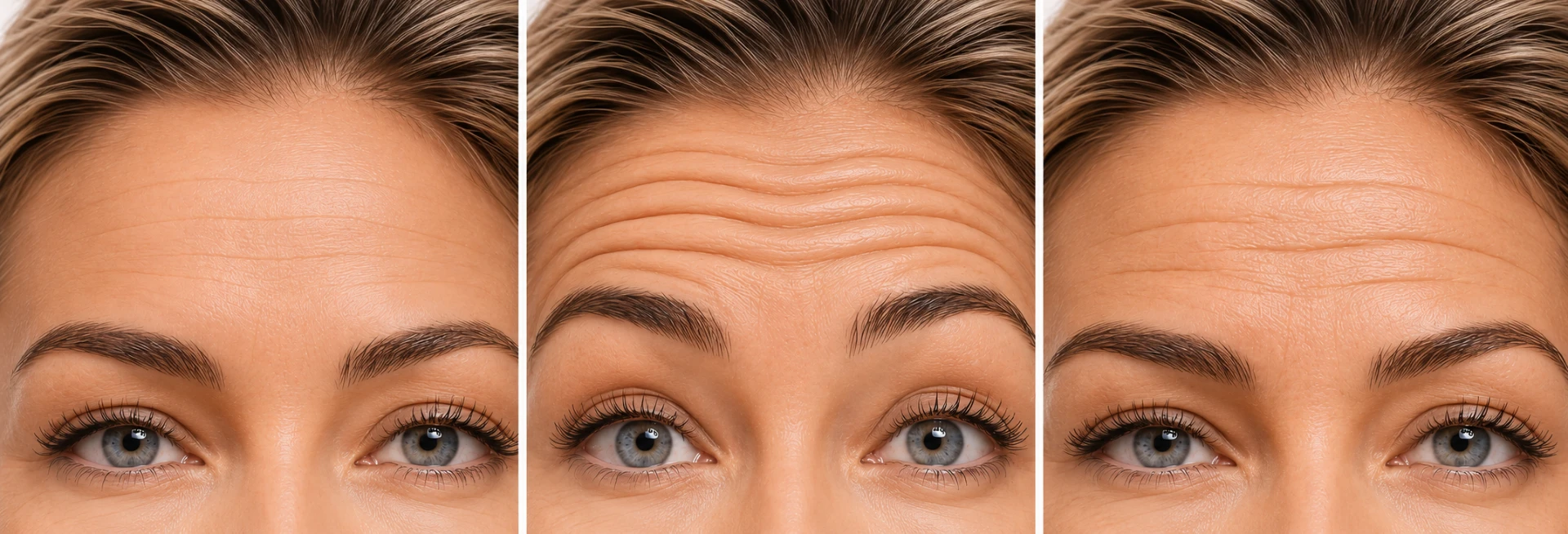
How do anti-wrinkle treatments work?
Anti-wrinkle injections containing botulinum toxin type A work by temporarily reducing the activity of targeted facial muscles.
By relaxing the muscles responsible for repeated expression lines, the skin above them is folded less frequently.
This helps soften existing dynamic wrinkles and can help reduce the progression of expression lines becoming more deeply established.
Treatment is carefully tailored to the individual, with the aim of achieving a refreshed, natural-looking result while maintaining appropriate facial expression. A prescribing consultation is required before any anti-wrinkle treatment.
But here's something important to understand…
Relaxing the muscle doesn't automatically remove a crease that has already formed within the skin.
This is where the difference between dynamic and static lines becomes particularly important.
—3. Static Lines: When Wrinkles Remain Even at Rest
Static lines are wrinkles that remain visible even when your face is completely relaxed.
You may notice them across your forehead, between your eyebrows, around your eyes or around your mouth.
Unlike dynamic wrinkles, these lines are no longer solely dependent on muscle movement. They have become established within the skin itself.
Why do static wrinkles develop?
Static lines often develop through a combination of repeated facial movement and progressive changes in skin structure.
Over time, several processes contribute:
- Collagen loss: Reduced collagen affects the skin's structural support.
- Elastin damage: The skin becomes less able to spring back after being folded.
- Repeated muscle movement: Years of facial expressions can gradually etch lines into the skin.
- UV damage: Cumulative sun exposure accelerates the breakdown of collagen and elastin.
- Reduced skin thickness and resilience: Age-related changes make the skin less able to recover from repeated creasing.
Think of it this way: imagine folding a piece of paper repeatedly in exactly the same place. Eventually, even when you unfold it, the crease remains visible.
Skin behaves differently from paper, of course, but the analogy helps explain why some lines remain even when the underlying muscle is relaxed.
Why anti-wrinkle injections alone may not be enough
This is something we regularly explain during consultations.
Anti-wrinkle injections can relax the muscles responsible for dynamic wrinkles, but they cannot directly rebuild lost collagen, restore elastin or remodel an established crease within the skin.
You may therefore achieve a reduction in muscle movement but still notice a visible line when your face is at rest.
This doesn't mean your anti-wrinkle treatment hasn't worked. It means the concern may now involve the skin's structure as well as the underlying muscle.
The solution? Treat the skin as well as the movement.
At FAM Clinic, we may recommend a combination of treatments designed to improve skin quality and support collagen remodelling.
Which treatments can help static lines?
1. Medical-grade skincare – Vitamin A (Retinol)
A well-designed skincare routine is an important foundation for improving the appearance of ageing skin.
Cosmetic retinoids such as retinol support cellular renewal and collagen remodelling.
With consistent use, they can help improve skin texture, soften the appearance of fine lines and improve the overall quality of the skin.
However, deeper established lines are unlikely to disappear through skincare alone.
Daily broad-spectrum SPF is equally important to protect collagen from ongoing UV damage. You can browse our medical-grade skincare in the FAM Clinic skincare shop.
2. Microneedling – Supporting Natural Collagen Production
Microneedling is a collagen-stimulating treatment that encourages the skin's natural repair response.
By creating controlled micro-injuries, it stimulates a wound-healing cascade involving fibroblast activity and the production of collagen.
Over time, this can help improve:
- Fine lines and superficial static wrinkles.
- Skin texture and smoothness.
- Skin firmness and elasticity.
- Overall skin quality.
A course of treatments may be recommended depending on the depth of the lines and the condition of the skin.
3. Neauvia LaserMe – Fractional Laser Skin Rejuvenation
For clients concerned about established lines, uneven texture and visible signs of ageing, LaserMe in Cambridge offers another approach to skin rejuvenation.
This non-ablative fractional diode laser works by delivering controlled thermal energy into the skin, supporting collagen remodelling and tissue renewal.
Unlike treatments that simply target facial muscle movement, LaserMe focuses on the quality and structure of the skin.
It can be incorporated into a personalised skin rejuvenation programme to help improve the appearance of fine lines, wrinkles and uneven skin texture.
Treatment suitability, expected results and the number of sessions required will depend on the individual.
—4. Why Combination Treatments Can Deliver Better Skin Rejuvenation
One of the most important things to understand about facial ageing is that it rarely has just one cause.
You might have dynamic forehead lines, static creases, reduced collagen, dehydration and uneven skin texture at the same time.
Treating just one of these concerns may leave other aspects of skin ageing unaddressed.
This is why we believe in a combination approach. Rather than relying on one treatment to do everything, we consider how different treatments can complement one another. For example:
Anti-wrinkle + LaserMe
Anti-wrinkle injections address the muscle movement contributing to expression lines, while LaserMe focuses on improving skin quality and supporting collagen remodelling.
Anti-wrinkle + Microneedling
Relaxing targeted facial muscles can reduce repetitive skin folding, while microneedling stimulates the skin's natural repair and collagen production processes.
Skincare + In-clinic
A consistent homecare routine incorporating Vitamin A, appropriate moisturisation and SPF supports skin renewal and helps maintain the condition of the skin between professional treatments.
The aim is not to make the face look frozen or overtreated. It is to achieve healthier-looking skin, softer lines and natural-looking rejuvenation.
—5. Fine Lines and Wrinkles Treatment in Cambridge: Which Is Right for You?
The first step is understanding what is actually causing your lines. As a simple guide:
Of course, every face is different. The depth of the lines, skin condition, medical history and individual goals all influence which treatments may be suitable.
—The FAM Clinic Approach: Treating Skin, Not Just Lines
At Fine Aesthetic Medicine Clinic, Cambridge, we believe that successful facial rejuvenation starts with understanding the skin.
Our medically-led approach combines clinical knowledge, advanced technologies and carefully selected medical-grade skincare to address the different aspects of skin ageing.
We look beyond the individual wrinkle to consider collagen health, skin texture, hydration, elasticity and the underlying causes of visible ageing.
Whether you are considering anti-wrinkle injections, microneedling, LaserMe or a tailored medical skincare programme, our focus is on creating a treatment plan that is right for your skin.
Because smoother-looking skin isn't just about relaxing a muscle. It's about supporting the health and quality of the skin itself.